Tuesday, March 11, 2008

Pin-stripes

Marfy 1469. From the Marfy Fall 2007 catalogue: "This flared skirt is divided into panels cut on the grain and on the bias. Suggested fabric pinstripe"

The hard part of making this skirt is cutting out the pattern so as to get the stripes on the bias strips going the right way. I spent a long time working it out and then, finally giving in and asking for James' help, I managed to do it...wrong! But I only made one mistake and I was able to switch the incorrect pieces and draw new stitching lines so there was no problem in the end.

My choice of this pattern was all about the fabric. There is a store in Kamata (Yuzawaya) that sells fabric for men's suits on the top floor. Actually what they do is make suits for men. You pick your fabric from a very large selection and they make the suit. However, (if you persist and find the right assistant) they will also sell you fabric by the metre. I have long wondered what I could do with this fabulous resource (apart from make James a suit which he doesn't really need) so when I saw this pattern in the Marfy catalogue I jumped at it. I thought it was the perfect piss-take on pin-stripe. So in this case I even followed the Marfy fabric recommendation! You might think this is not so extraordinary but Marfy do suggest some outrageous fabrics. Things like "vicuna"!!!

I decided on black with blue stripes and one of the samples I really liked was at half-price, so I requested 1.5m. It was a Super100s Japanese wool. Then it turned out this fabric was end-of-line and the assistant decided to give me the whole 3.3m. I'd only asked for 1.5m so I got that length at half-price and then the extra 1.8m free! Unbelievably that means I got 250 US dollars worth of fabric for about 55 US dollars and of course it means I also have enough to make a suit.

After cutting out I finished all the edges of the pieces with an overlock stitch to avoid fraying. I am a little under size 42 in the hips according to the measurement chart and in fitting I took 1cm off the-right side seam. In the left side I installed an invisible zipper. I cut the full length, but aware that it would be shortened quite a bit I increased the flare a little. In the end I tried several lengths and decided that mid-knee length looked best, which, including a 2.5 inch hem, meant cutting a couple of inches off the bottom. I hand-sewed the hem, and also added a black silk charmeuse lining. I had some problems sewing this fabric. The bobbin seemed to be sticking. It didn't actually effect the stitches that I could see, but the thread did not seem to come off the bobbin smoothly. I never quite tracked down the problem although it did seem to improve a lot when I used a size 7 needle...I hope my machine isn't peaky.

The fit is really good, and it looks very nice to me in the mirror, although photographing this skirt is rather a challenge. I think it's very cool - no one else on the train to Tokyo has half their pin-stripes at 45 degrees!

review

Saturday, February 02, 2008

Black jeans

James wanted some new black jeans. Choice is limited since James takes between 32/36 and 34/36, the second number being the length and the first the waist measurement. Such jeans are rare in most parts of the world and probably non-existent in Japan. He has some 34/36 501s but they have always had an up-the-bum-crack issue. We looked in Levi's while in San Francisco last year and the latest 34/36s are much worse fitting. Basically, the 34 label now applies to a fatter arse (odd since I thought it was supposed to be inches), and of course no 32/36s in the shop at all.

The jeans James has that mostly fit are 32/36 Wranglers. Problem is these are actually a bit tight across his lower back and he doesn't like to wear them for long periods, especially after he slipped a disk a few years ago. Those jeans are also blue.

So the aim - transform the Wranglers into black and a slightly looser fit.

The big cheat was that James had 2 identical pairs of the Wranglers so I took one to pieces and drafted the pattern pieces as close as I could to the originals. I also stuck as close as I could to the construction used in the originals, without which I think that the result would not look very RTW. To start with I added 5 cm at the waistband tapering to nothing at the hems. Then during the fitting stage I took off 2cm above the hips - so I reckon this means they are basically size 33/36, in old money. The only thing is that I didn't allow quite enough hem allowance so they are about 1cm shorter than they might be.

These jeans were a rather amazing construction journey. The pockets were pretty standard. The only extra piece is a piece of pocketing attaching the pocket to the flies.

From the fly onwards construction is completely different to usual pattern construction, because of the lapped seams. First the right hand side of the zipper is sewn. Then the left, and then the front crotch seam is lapped. The willy guard (zipper guard?) is interesting since it is basically a rectangle with a fold in at the bottom which adds some bulk. I guess it is deliberate! For a more "manly" effect. For the crotch the back and front are sewn before the inseam.

If you look at the lapped seams on your jeans you will see they look the same from the right or wrong side, whereas a home-sewers lapped seam does not (at least in instructions I have seen). I guess they have special machines in the sweat-shops. To make it look like RTW, first lay half the seam allowances over each other, and pin or baste in place. Then turn the seam to take up the rest of the seam allowance, pin and baste. Then sew the stitching lines on the machine. I was greatly helped in this tricky endeavour by magical thread that is sold in Japan that melts when ironed. It really only sticks to a basting level, not a permanent hold. I used this for my first line of basting and so when I turned the seam and ironed, the full lapped seam was lightly stuck in place. This was particularly useful for moulding the curved back crotch seam.

The waistband was fun. It is just a piece of fabric, folded in half, seam allowances ironed in place and then top-stitched all the way round. That was actually a whole lot easier to construct than the usual pattern method, although I realise that I have one line of stitching where in home-sewing there would be three. I did add some stay-tape at the waistband to prevent stretching.

Medium weight denim, black on the front and olive on the back. This pair is mid-weight denim and he would like a thicker pair some time. That of course would be harder work with the sewing - my machine handled the mid-weight denim very well. Summer should however save me from making another pair very soon.

I even ripped off the Wrangler back pocket pattern... Here is the boy relaxing in his new jeans.

I entered these in the PR 2008 rip-off competition. Winning entries in that competition are usually inspired twists on commercially available patterns that make them look cunningly designer cat-walk. Obviously this entry falls short on many levels, but its the taking part that counts init...

Saturday, January 19, 2008

Overpowered by flowers

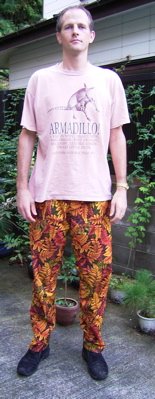
I bought this lovely fabric in Keitoya in Kamakura. It is a 4-way stretch cotton woven, with a lot of stretch along the grain and less stretch across the grain, relatively supple considering its weight, quite warm and very comfortable. However, when I got it out of the fabric pile, James kept pulling faces and covering his eyes, and I had to teach him what stitchin' people in the interwebworld say when they dig unspeakable fabric from their stash, and that is "what was I thinking?". This enables one to pass off fabric one thinks is lovely off as a blunder when one discovers that the rest of the world disagrees. I'd thought a pair of trousers in this fabric were just the ticket for work or play. After all, it seems nothing clothing-wise is a step too far in Japan.

This is Marfy Pattern #1058. It was in the Fall 2007/2008 issue but as evidenced by the Marfy patterns on the Vogue patterns website, it is not new. The pattern appears in the catalogue twice. The first entry they are pictures with a loose shirt/tunic and called "tapered hip-hugging pants", the second time pictured with a quite minimalist jacket they are referred to as, "straight pants with pointed hip-hugging waistline". On the Vogue Patterns site they are in the Marfy Autumn/Winter 2006 collection and pictured in a third ensemble with this text, "These straight, hip-hugging trousers have a wide inserted waistband".

I cut the trousers on the line of less stretch in the fabric which was the cross grain. This means the pattern is sideways, but I decided it was better that way round since it elongated the design. I made the trousers assuming from the Marfy size chart and previous experiences with their patterns that I may have to take them in a bit at the hips. The fabric is very stretchy and I took 2cm at the back seam allowance (just in the top ~10cm) and 1cm each side seam allowance (all the way down). It was then I realised I hadn't sewn the back darts! No trousers I have sewn before have had these so I missed them. The fabric is so stretchy that I was able to take the 1cm darts, which improved the shape, without much trouble, although the waistband is a tad short with all those cm removed. I am not sure I have learned so much about the pattern since my fabric is so forgiving, but these were a much easier fit than the Vogue trousers I have made, where I had to change the shape of the side and crotch seams and waist band.

I only noticed while perusing the vogue patterns site and the Marfy catalogue to write this post that the waistband is secured with two buttons and that there are belt-loops on the catalogue photos. The two buttons would have been a good idea since the waistband is quite wide. As for belt-loops I can add them later if I can find enough fabric - I don't have much left. Since it was rather expensive I did not buy much excess.

A size 11 universal needle worked best - a thicker one made holes. I used Resilon thread a straight stitch and I finished all the edges with an overlock stitch.

Here are some pictures of the, erm, ensemble of black cotton jumper and flowery trews. The camera has difficulties exposing on both items simultaneously, as I expect do most peoples' eyes. I still like these trousers and even James admits they are "fun".

review

Cotton jumper

When I was 17 or 18 my Mum bought me a black knit cotton jumper. It is a slightly odd fabric, like it is made of string. It shrinks when washed and then stretches in wear, a bit like denim does, only more so. Anyway, this jumper no longer has much shape, but I kept it because a smartish-casual (ie not sporty) black jumper is a versatile thing. However, when I found a knit in Yuzawaya (Kamata) that had a similar feel I though I should make a replacement. The fabric is a sheer, or perhaps it might be called a holey knit. It is so cold at home and work in winter that we rarely actually remove our jumpers to show what is underneath, so I thought it was a positive feature to be able to see through the fabric. Having worn the jumper for a week I don't think this fabric is as hard wearing as the original so I have doubts it will be around in 20 years.

I took the pattern I used for this jumper, which in turn was stylistically derived from Burda 8291, and added ease (2 inches total = 1/2" at each side seam) at the bust and waist to make a less fitted top. The hips always seems to stick out on the other versions so I did not add any ease there. I then redrafted the sleeve in order to make it a bit looser. A strange thing happened when I did this because I made a mistake and equated the lengths of armscye and sleeve cap not on the stitching line but at the edge of the pattern pieces. This results in the sleeve cap being too short. However, in the original pattern I had released a dart at the armscye, and it was just about the same size as the error induced by my drafting mistake. So I took the opportunity to ease the dart fabric as was taught in Sharon Gifford's T-shirt class on PR . Due to the willingness of the fabric to shrink and stretch under the iron, this worked far better than I expected. Until then I'd not got this to work that well. Now I think the key is in how the fabric reacts to the steam iron.

I used a size 14 needle, put Resilon thread in the bobbin, and used a straight stitch for some of the seams (double back-stitch for the hems). Resilon is a Japanese thread in size 50, that has some stretch and is also rather strong, which makes it possible to use a straight stitch in garments with small to moderate stretch. I sometimes use it in top and bobbin, but it has a tendency to spring off the reel and then twist up, especially at the start of the reel.

Thursday, January 03, 2008

jumper re-form

This was originally a practice run for a pertex cycling top, which later became world famous. However it has turned out to be a very popular fleece top for wearing in the mountains. James uses it as apres-walking wear in the drafty huts during summer and walks in it in the winter. I highly recommend windpro fleece; it really does make a far superior jumper for cold conditions. Yesterday James complained that he didn't like the cuffs. He said they were cold. As the pertex practice these were created using a simple hem with elastic cord in them. I have now replaced this by more normal cuffs made from powerstretch.

A re-form is what you do in Japan when you want to change your fixed interior decor. So you replace your white walls, white ceiling and wooden floor by, say, white walls, a white ceiling and maybe a wooden floor. Or you might replace your kitchen cupboards with kitchen cupboards. Of course if you want to spend a fortune it can be more extensive than this involving knocking holes in the walls and such like. Since we rent our house we can't do any of this. So we just have to put up with white walls a white ceiling and a wooden floor. I don't mean to sound too sarcastic. I actually really like the simplicity of Japanese decor.

Tuesday, January 01, 2008

Jumpers again

One lunchtime during the AGU in San Francisco we popped into Sak's 5th Avenue Men's Store, which isn't on 5th Avenue at all, but just of Union Square. How silly to forget to rename their store when they went to SF. The shop is tiny compared to the other bit of the shop (the wimmins section?) which runs for almost the whole length of one side of the square. Anyway, inside S5AMS were lots of lightweight fluffy jumpers costing hundreds and hundreds of dollars. One might have been tempted only a badly fitting jumper is still a badly fitting jumper no matter the fluff-factor or the price tag. So, by way of getting some fun in famous Britex fabrics which is nearby, I suggested to James that we go and buy some fabric and make a fluffy jumper ourselves. Britex is an odd shop. You can't really browse. You tell the staff and they find you what you want from their stock. Fine for us since we'd just been feeling up the fluffy stuff in S5AMS. They sold me 2.25 yards of a 60 inch wide black wool knit for $50 a yard. It really was only just enough with no room for cutting error. It's smarter and less fluffywuffy than the stuff in S5AMS. I think it's high quality, and I expect it to wear well but time will tell.

So then it was back to KS2561, for the third time in the year. We decided to make it a bit slimmer than the previous version made with quite thick (and very fluffy) fabric, so trimmed the pattern down by 0.25" on the side seams, tapering the arms to their original side at the cuffs. Got confused again by the sleeve length. My tracing stated the adjusted pattern had been lengthened by 1.5" compared to the original but when I compared the two, it was much less than that. so I retraced it to 1.5" extra length. Of course when it came to it I had to take that extra length (5/8") off again! I've also now adjusted the cuffs to be narrower than the original pattern piece because I prefer them shorter.

So now having a properly adjusted pattern, James wanted another longsleeve T-shirt. The fabric to be used was this buttermilk. It is quite lightweight and I did wonder if it would be too light for men's t-shirt. I'd not sewn with buttermilk before. It really isn't all that stretchy. Pretty much no stretch along the grain and not that much width-ways. These features conspired to make James complain that the sleeves are now too short!! tsk! The problem is mostly that the tighter neckband (less width-ways stretch) pulls the neck higher, but the lack of length-ways stretch also contributes. So now I have a note on the pattern piece to lengthen it an inch for the crew neck version! A v-neck in this less stretchy fabric would I think really require a longer neckband. Another thing about buttermilk is that it ladders - so I got to use one of the very fancy over-lock stitches on my machine which was quite fun. A good feature of the low-stretch fabric was that I didn't get any stretching of necklines and hems. A less good feature is the fabric seems attracted to other fabric. It doesn't cling to skin but it does to under-Tshirts or over-jumpers, as can be seen in the photos of both the shirt and the jumper in this post.


Saturday, December 22, 2007

Hoodie Hug

This week James got even older. To celebrate he got some teen wear - another hoodie. This one is made from 100 weight fleece (which is their lightest but actually it is still quite thick) from Malden Mills. It has a lower nap on one side (MM call it velour), and I chose that for the outside. The main thing, which isn't really apparent from the pictures, is that the garment is better stitched together than the first one. I could pretend this is due to an improvement in skill but in reality my stitches took a big step change for the better upon purchase of the "new" sewing machine almost a year ago. I had to re-trace the pattern since the previous tracing was used up making the pertex top pattern. The sleeves are shortened about an inch compared to the last one, but I forgot to lengthen the back so ended up cheating the hem a bit to make up.

Saturday, December 01, 2007

V-neck for Pa

I made another V-neck jumper like this. The fabric is almost identical, a wool/angora mix, but much cheaper; it was bought from the closing down sale of the second Keitoya store in Kamakura in May of this year. This one is for my Pa who I measured while we were on holiday together last month.
I made medium size, but cut it a bit shorter - along the S-line at the front. I added an inch at the chest and took 2 inches off the hips. I shortened the arms by half and inch, with the intention of making them 2 inches shorter than James'. After tacking on the cuffs and trying the jumper on James, I was dismayed to realise the arms were not really short on him so I took off more while making it by sewing the cuff on with a 1.5cm SA.

The jumper is Pa's Christmas present. Shockingly it seems to fit. The pictures are rather dark. I suppose that's just because there aren't so many photons in the UK.

Tuesday, November 20, 2007

Marfy Jacket

Although hardly a quick job, this jacket did not take quite as long to make as it seems from the length of time since I last posted. We had a holiday in Colorado and Utah, and I finished the jacket shortly after my return. Then it took a while to do the photo-shoot.

The jacket is made from some sort of synthetic suede, bought for not very much from Swany in Kamakura. The edges do not fray. It was possible to un-pick and re-stitch a row of stitching, but perhaps only once before the fabric starts to ruin.

After lengthy consideration of the pattern sizes I bought size 42. In theory this size should be a little tight at the bust and a little loose at the hips. I made a muslin from a very cheap cotton woven. I ended up lengthening the jacket by 3cm, decreasing the shoulders by 1cm each side, and taking in the waist at the back side seam, by about 1cm each side. This last adjustment also meant adjusting the un-belt feature on the back. The final result on the real-fabric is fine but is a little snug at the bust and a little looser at the hips! I realise what I did wrong wit the muslin - I only attached one arm so did not properly check the fit at the bust/across the the back.

No instructions with Marfy patterns, so the muslin was very useful for practising how to make the jacket. For the basic construction I used Kenneth King's foolproof CD for a Tailored Jacket and this time (unlike last time) I interfaced the jacket body with some sort of hair cloth (I never really know what I am buying in Japan!) from Yuzawaya in Kamata. One super thing about this CD in combination with a Marfy jacket, which comes with no lining pieces is that Kenneth's techniques fit together best if you draft your own lining from his finely detailed instructions.

This jacket has quite a few features which deviate from a classic jacket. There is an extra front piece, of rather an interesting shape. Then there is a pocket and a kind of flap thingie. I think the people at Marfy are just having fun making a puzzle! I also puzzled a bit over the cuff and I am not sure I did that quite right since my method was rather fiddly, and I think resulted in a slightly weak point. The front of the jacket is done up with a centred zipper. Because I was using fake suede, which does not press very well, I faced and understitched the hem and cuffs. I also interfaced these facings with tricot fusible. I used various bits of interfacing elsewhere, fusing a woven onto the front at the "flap-bit", reinforcing the back with tricot fusible where the snaps attach (I used snaps throughout - I thought snaps and zippers might go together) and I also interfaced the pockets with a bit of quilting cotton (I don't quilt - I make trews for my James!). I also lapped most of the seams, for reasons of suede.

The lining was bought from Yuzawaya in Kamata and is a thicker than usual purple cupro. Kenneth's CD has a really nice lining method with piping and a magnificent inside pocket. The piping on the lining is made from silk duppioni.

I used 60 weight thread and a size 12 microtex needle for non top-stitched seams. For the top-stitching (of which I did lots) I changed the top thread to a 30 weight thread and used a size 16 topstitch needle. I had trouble with the top-stitching at the hem - it might need redone but I left it to see if it holds. However, after that debacle I hand-stitched all the way round the fronts and collars. That did take quite a few evenings - I can only do so much before getting sloppy and this really had to be as neat as I could do (which isn't really very neat).

I like the final result although people do keep asking me if I made it so it must look home-made or weird in some way. tee hee! The Japanese are very kind. Not like those Americans. When we were in Boulder on holiday some incredibly tatty fellow came up and told James he was wearing the ugliest pair of pants he'd ever seen. These lovely autumnal beauties were the culprit.


Sunday, September 16, 2007

A Scot-Jap stylee shirt

I had another go at the Kwik Sew shirt this time using quite a bit of the information in D.P.Coffin's Shirtmaking book.

It is Scot-Jap because the collar and general style is taken from James' fave (but defunct) shirt bought in Ayr, Scotland, but the fabric, being lightweight silk from Keitoya in Kamakura is not something I think you could ever wear down a wind-swept Ayr high street. Well, maybe if global warming _really_ kicks in...

You can read all the details of the alterations I made on my review. The bit I remain unsure about is how wide the sleeves should be. I did not alter this aspect significantly in my alterations and I wonder if they are a bit loose. As DPC explains in his book, if you increase the sleeve cap height you make the sleeve point more down towards the ground and decrease the width of the sleeve. I couldn't experiment with this here because needle holes show in this silk and with that and the 1/4" seam allowances I think putting in a new sleeve would have caused rather a mess. Next time maybe...

James always has problems finding long sleeve shirts that fit because they were always too short and fat. But for short sleeve shirts, he just buys UK medium sized because they fit he body. Initially I was very confused when I saw how looong the sleeves were on this shirt. Then I looked up some shirt shops on the interweb and found lots of pics of men in short sleeve shirts with hems falling at about the elbow. What a revelation!

Sewing machine notes:
Used a size 10 microtex needle, because it was the one that didn't go "thunk thunk thunk" as it stitched this fine fabric, and #90 thread. Finished raw edges with a 3 step zig-zag using edge finishing foot.


Sunday, September 02, 2007

Marfy rugby shirt - 1493

I guess the Italian women's rugby team don't really dress like this on the field, but this is like a mix of a blouse and a rugby shirt with the addition of trendy empire waist and feature pleating. Actually I am not sure that every place Marfy write "pleat" on the pattern they mean it - I think sometimes they might mean "gather". Like on the back of this top, I think you are supposed to gather the top into the bottom. I sewed pleats and James thinks they are "a bit funny".

It is all a bit funny really, but since Marfy patterns are well-known to be "fashion-forward", this means that everyone else in the world will be wearing this style soon even though they don't realise it yet. Until then I will just have to put up with the funny looks. Actually I think "fashion-forward" might really mean "daft and will never catch on but if I call it 'forward' you fools will buy it anyway".

Actually I love this top. I made it from some super 4-way stretch tencel knit found in Yuzawaya, Kamata for 3300¥/m. Splutter. The fabric is light yet cosy. Nice for this time of year when it is still hot but a little cooler than scorching and yet shops and can be a shade cool with the aircon still going.

This is the second pattern in my size included in the Marfy Autumn-Winter 2007/2008 catalogue. I cut a size 42 with confidence even though the bust measurement of the pattern is a little small for me, because I knew the stretchy fabric would give me extra to play with. I ended up sewing 3/8" inside the Marfy sewing lines for the sides and arm seams.

I've only done 2 Marfy patterns but found them such fun that I have now placed an order for several more. Stupidly I like the no-instructions style. It is stupid because a sensible person could have as much fun throwing away the instructions on other patterns, but it doesn't seem to work like that. If they are there I have to follow them, because I am a good girl! I like that the patterns come with lots of little pieces (easier to cut out accurately) that you have to work out how to put it all together. In one way it is like an exam - you have to remember what techniques to use, or at least where to look them up. On the other hand it is kind of liberating because you get to decide where you think it is OK to take shortcuts without having to feel like you cheated. Well the really cool thing about the patterns is the way the seams of all the little pieces slide together like magic into such interesting shapes.

review